
Workflow friction is costing your pathologists 1–2 hours every day.
Those hours show up in errors, burnout, and longer turnaround time. VoiceOver PRO® is the pathology-specific reporting layer that sits on top of your speech engine and your AP/LIS, giving every pathologist or PA those hours back.
Trusted by leading pathology labs and health systems


























When radiology went digital, reporting moved into the imaging system. Pathology is next.
VoiceOver PRO is the only pathology reporting layer that works with both your AP/LIS and your digital pathology platform, uniting them into a single reporting workflow. Active deep integrations with PathAI, TechCyte, FUJIFILM, Corista, Gestalt, PathPresenter, Lumea, and more.
- Report authoring on top of your digital pathology platform
- Deep integration that works with any AP/LIS
- One reporting workflow whether the pathologist starts in AP or DP
Prefer to read? Skip ahead to the product breakdown.
Pick the right tool for your lab
Most customers choose VoiceOver PRO, the reporting layer for the whole lab. Accelera is the entry-tier option for labs that want pathology-aware dictation without the full PRO platform. SynoptIQ® adds CAP synoptic cancer reporting to either one.
Pathology-aware dictation for the entry tier
The scale-down entry tier: pathology-aware dictation for labs that want pathology workflow on top of their speech engine without the full PRO platform. A smarter alternative to generic dictation, not a replacement for PRO.
- Front-end speech and digital dictation with delegated editing
- Hands-free grossing, voice commands, and editable templates
- Hosted and centrally managed; downtime resilience built in
- Per-user scale-down, with a clear upgrade path to VoiceOver PRO

The orchestration layer on top of your speech engine, AP/LIS, and digital pathology systems
Not a speech engine. Not an AP system. Not a digital pathology platform. VoiceOver PRO is the pathology-specific orchestration layer that ties all three together, brokering data and driving command-and-control across each so reports are created faster and more accurately. Deployed on top of hundreds of existing Dragon Medical One and Solventum Fluency implementations, integrated with 20+ AP systems and 10+ digital pathology platforms.
- Engine-flexible: DMO today, Fluency or Dragon Copilot tomorrow — no rebuild
- 20+ AP systems supported: Clinisys (CoPathPlus, PowerPath, Orchard), Epic Beaker, Oracle Health/Cerner, more
- 10+ digital pathology integrations: PathAI, TechCyte, FUJIFILM, Corista, Gestalt, PathPresenter, Lumea…
- CAP eCP validation, hands-free grossing workflow, downtime continuity built in
Synoptic cancer reporting add-on
A focused cancer-protocol add-on to VoiceOver PRO or Accelera, with field-level validation, staging and grading rules, and HL7 output for cancer registries. It works alongside any reporting system you're already running.
- Automatic CAP eCP updates, customizations preserved
- Auto-staging, auto-grading, field-level validation
- HL7 output for cancer registries
- Drop-in with any AP/LIS: no direct integration required
Your transcriptionist used to catch this. Speech alone doesn’t.
When labs moved from transcription to direct speech recognition, pathologists gained speed and lost a second set of eyes. Speech engines convert dictation to text. They don’t catch the misrecognitions that change the diagnosis. And it isn’t about which engine you run. They are all good enough at turning sound into words. It is about how much of the report is left as free-text dictation for a misrecognition to hide in.
A factor-of-ten size error changes staging, prognosis, and the treatment plan.
A flip means a wrong-side surgical decision built on a wrong-side report.
The report attaches to the wrong patient's chart.
One missed word inverts the diagnosis.
“VoiceOver PRO is faster, it’s more accurate, and the responsibility is with the doctor beginning to end.”
VoiceOver PRO is the safety net at sign-out.
PRO keeps most of the report structured, not free-text: protocol-driven fields, synoptic elements, and voice commands that select rather than transcribe. Less of the report is exposed to a misrecognition in the first place, and what is exposed gets checked: field-level validation, required data elements, laterality checks, auto-staging, and case-number reconciliation against your AP/LIS, applied to every report before it goes to the treating physician. PRO is the second set of eyes pathologists used to have, made better. Here’s how customers say it catches errors in their own labs:
“PRO’s validation features detect if required information is missing, or if a value is outside of normal limits. PRO will then prompt the user to take action before finalizing the case.”
“With our VistA AP system, especially for big reports like gross dictations, the formatting and the amount of errors we would get with Dragon would basically not allow us to use that system. We’d have to reread everything, line-by-line, to make sure there wasn’t an error. Dragon by itself wasn’t a really good solution to replace transcription.”
“It’s easy for us to miss something or forget it. PRO tells you that you didn’t fill in an area. I had it set up with a hard stop, so I can’t finish it without filling in all the blanks. That keeps me from forgetting something.”
Speed without accuracy is just a faster way to be wrong. VoiceOver PRO catches what speech alone won’t — before the report leaves the lab.
Read more customer stories of PRO catching real errorsSpeech engines are a commodity. The pathology layer isn't.
Dragon Medical One. Solventum Fluency. Microsoft Dragon Copilot. Each one works. None of them change what your pathologists actually spend their time on. VoiceOver PRO sits above the enterprise speech engine your IT team already chose, with the capabilities a pathology report actually requires.
Orchestrating your AP/LIS and digital pathology
VoiceOver PRO sits on top of whatever AP/LIS and digital pathology platform your lab already runs and orchestrates across them: case context flows in, voice commands drive each system, and structured reports flow back as the system of record. It works in tandem with your systems, not buried inside them and not off to the side. Deep integration spans 20+ AP systems (including Clinisys CoPathPlus / PowerPath / Orchard, Epic Beaker, Oracle Health/Cerner Millennium PathNet, SCC SoftPath / SoftPathDx, MEDITECH, VA VistA) and 10+ digital pathology platforms (PathAI, TechCyte, FUJIFILM, Corista, Gestalt, PathPresenter, Lumea, and more). The only orchestration layer across both.
CAP eCP + synoptic, data-driven reporting
Voicebrook is an authorized provider of CAP eCP content. Cancer protocols update automatically — your site customizations preserved — with auto-staging, auto-grading, and required-field validation built in. Reports aren't free text; they're structured, data-driven, and flow as HL7 to cancer registries and tumor boards. This is the layer most workflow tools simply don't have.
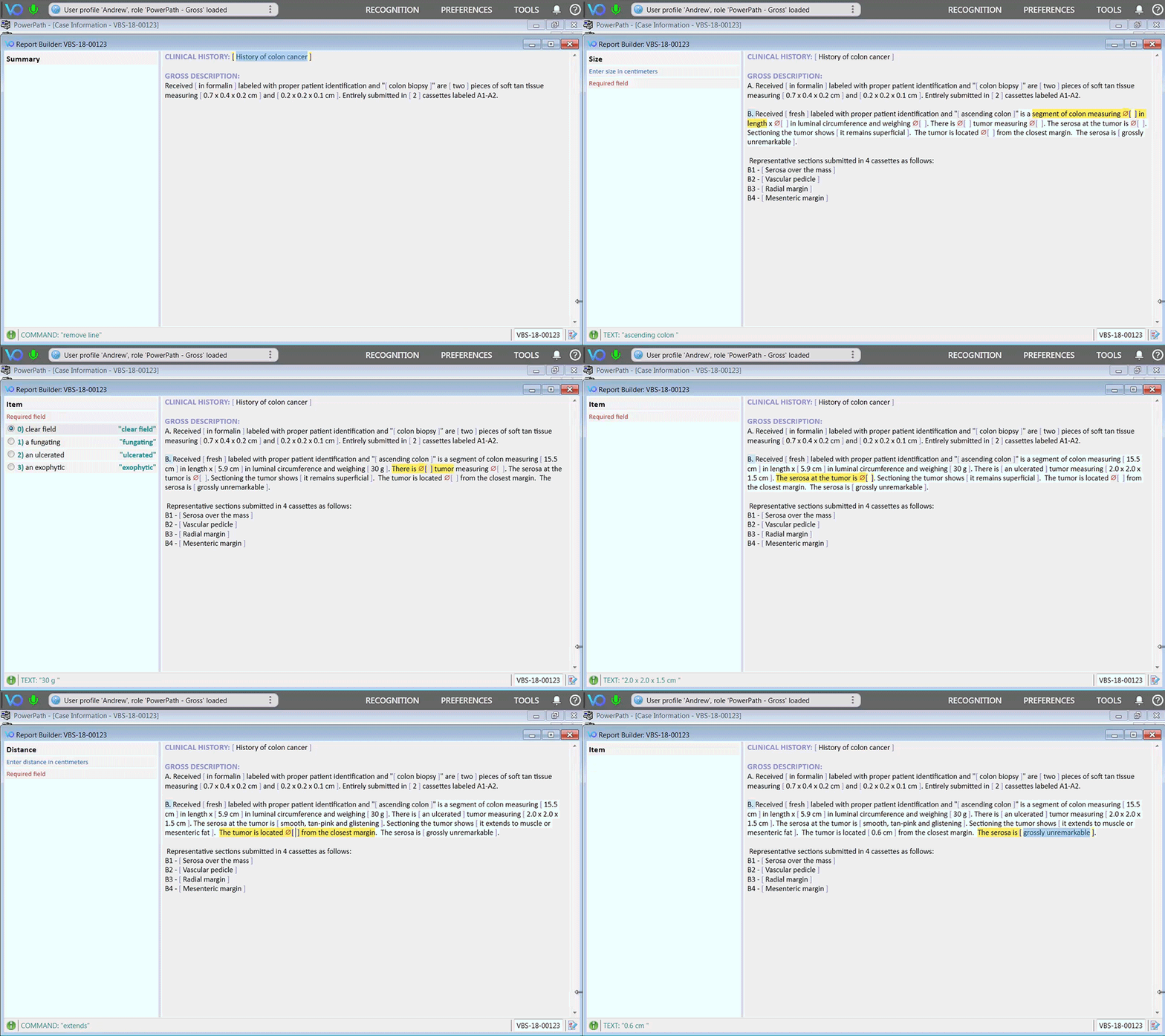
The whole case: gross, micro, diagnosis, sign-out
Most speech tools only show up at final sign-out. VoiceOver PRO covers the entire case: hands-free gross descriptions at the bench, microscopic findings and diagnosis at the scope, and CAP-validated sign-out. Wireless mics, foot pedals, and water-resistant equipment for the grossing room; voice-driven navigation through the diagnostic workflow. The whole case, end-to-end.
One platform, many workflows
Front-end speech, delegated workflow with transcription QC, or full digital recording. Each user works the way they prefer, on one platform. Pathologists, PAs, residents, fellows, and per-diem coverage all sign cases through PRO without each needing a separate speech license. Delegated Medical Editing keeps transcription-assisted users on the same platform as everyone else.
Accuracy + validation safety net
Field-level validation prevents incomplete or inconsistent reports from being signed out. Required data elements, laterality checks, and case-number reconciliation catch errors before sign-out, and every report carries a complete audit trail. For the people accountable when a report is wrong, accuracy isn't a feature — it's protection.
Downtime continuity + engine independence
Pathologists can keep working when the network is down, the AP system is unavailable, or the speech engine hiccups. PRO's offline mode enables automatic sync upon reconnect. And because the engine underneath is a commodity, swapping it (Dragon Medical One → Solventum Fluency → Dragon Copilot) never rebuilds your pathology workflow. The layer is what persists.
We meet pathology labs where they are. Not the other way around.
No two pathology labs are the same. Different pathologists with different technical comfort. Different leadership styles. Citrix, VDI, or full desktop. Digital pathology in production, in pilot, or years out. Pathologists grossing, PAs grossing, or both. VoiceOver PRO adapts to all of it, and grows with you as your lab evolves.
From early adopters to reluctant adopters.
Some pathologists embrace front-end speech. Others won’t dictate at all. PRO supports direct dictation, delegated medical editing for transcription-assisted users, digital dictation for deferred review, and non-speech text entry. Many workflows, all on the same platform. No one gets left behind.
Mandate, opt-in, or start small.
Some lab directors mandate PRO across the department. Others let each pathologist decide. Many start with the willing pathologists and expand as comfort grows. PRO doesn’t require everyone to convert at once. The lab starts benefiting the moment the first pathologist signs out faster. You don’t have to wait for unanimous adoption to see ROI.
20+ AP systems, deeply integrated.
Clinisys (CoPathPlus, PowerPath, Orchard), Epic Beaker (Epic Showroom listed), Oracle Health/Cerner (Millennium, PathNet), SCC SoftPath / SoftPathDx, MEDITECH, LigoLab, VA VistA, and more. Acquisitions and AP-system migrations don’t reset your reporting workflow. In fact, PRO keeps your team working in a consistent environment, no matter what other changes you make.
Citrix, VDI, full desktop, or hybrid.
Some hospitals run everything in Citrix or VDI. Others use full desktop clients. Some have a mix across sites. PRO deploys in any IT environment. Your team picks the model that works for them.
DP in production, in pilot, or years out.
Some labs sign out from whole-slide images today. Others are piloting. Others won’t get there for a while. PRO works on top of your AP/LIS today AND on top of PathAI, Gestalt, TechCyte, FUJIFILM, and other DP platforms when you’re ready.
Pathologists gross, PAs gross, or both.
Some labs have pathologists gross their own cases. Others have dedicated PAs. PRO supports hands-free grossing for either role. We also offer wireless mics, foot pedals, and water-resistant equipment built for the gross bench.
Throw it at us. We’ve seen it. We have a solution — for where you are today, and where you want to be.
See the full integration directory: AP systems, DP platforms, speech enginesWhat PowerScribe is to radiology, VoiceOver PRO is to pathology.
Every health system that buys Dragon, Fluency, or Copilot for the enterprise also buys solutions like PowerScribe for radiology, a purpose-built reporting layer on top of the speech engine. The pattern is proven. The interoperability is solved. Voicebrook has deployed the pathology version on top of enterprise Dragon Medical One and Solventum Fluency installations at hundreds of health systems, often using the customer’s existing speech licenses plus the Dragon SpeechKit add-on to enable pathology vocabulary. Microsoft Dragon Copilot support is on the same path for later this year. What’s left is the operational decision: when does your lab stop carrying the capacity cost of going without?
Same pattern as radiology + PowerScribe, on top of the speech engine you already have.
Voicebrook has deployed the pathology reporting layer on top of enterprise speech installations at hundreds of health systems. In most cases the hospital wasn’t using Dragon for pathology yet. We enabled it using the customer’s existing Dragon licenses plus the Dragon SpeechKit add-on for pathology vocabulary. The same pattern works with Solventum Fluency today, and is on the same path for Microsoft Dragon Copilot later this year. The interoperability with whatever enterprise speech engine your IT team chose is a solved problem. We’ve been solving it for two decades.
Additive to your speech investment, not disruptive.
You can’t hire your way out of the pathologist shortage.
Pathology is in a structural staffing shortage projected to deepen through the decade. Case loads keep rising: more biopsies, more molecular results, more synoptic detail per case. Training pipelines can’t expand fast enough to close the gap, and the pathologists you do recruit cost more every year. The only lever that bends the math is efficiency. VoiceOver PRO recovers 1–2 hours per pathologist or PA per day. At a 30-pathologist department, that’s 3–6 effective FTEs back, without hiring a single new person.
Every month of delay is recoverable capacity you can’t get back.
Hospitals are cutting line items. The capacity picture is invisible to them.
Margin pressure has every hospital scrutinizing every cost line: transcription budget, software license, FTE. But cutting transcription while leaving pathologists fighting Dragon alone is penny-wise and pound-foolish. The productivity loss to reporting overhead doesn’t show up on the balance sheet — until you measure it. 1–2 hours per pathologist or PA per day, at fully-loaded comp, is more annual capacity than most departments could ever hire. In a cost-constrained environment, system-level efficiency is the only ROI lever that bends the math in your favor.
Capacity recovery is the only ROI lever you actually control.
Radiology has it figured out: a purpose-built reporting layer on top of the enterprise speech engine. Pathology works the same way — same diagnostic complexity, same structured-data demands, same medical-legal stakes, and now the same viewer-driven workflow with digital pathology. If anything, pathology demands more structure than radiology, not less, with CAP synoptic checklists radiology doesn’t even have. The difference was never clinical. It was that radiology claimed its seat at the IT governance table first, and pathology has earned the same specialty-specific treatment. The interoperability with your existing speech engine is solved. What remains is the math: every month a pathology department reports without the layer is capacity already spent.
You wouldn’t ask a radiologist to work without PowerScribe. Don’t ask your pathologists to work without VoiceOver PRO.
See how labs have put the layer in placeDigital pathology. AI. Smarter grossing. Your reporting layer has to be ready for all of it.
Pathology is advancing on every front at once: digital pathology adoption, AI moving into the diagnostic and reporting workflow, grossing-room technology, speech-engine consolidation, AP-system migrations. Whoever picks the reporting solution is accountable for a decision that has to work through all of these variables, for years. VoiceOver PRO is the constant: it sits above the speech engine, the AP/LIS, and the digital pathology platform, and it's where each new capability plugs in as it arrives. When the field moves, your pathologists' workflows, reporting protocols, and training move with it.
When the lab goes digital
Report authoring is migrating into the digital pathology viewer. Voicebrook already works on top of both AP systems and DP platforms: Gestalt, PathAI, FUJIFILM, Lumea, and more. The shift to digital doesn't strand your reporting investment, because the layer is already there.
When AI enters the workflow
Generative AI is the next big thing in pathology reporting. Voicebrook already ships AI features like DraftDiagnosis, Draft Procedure Line, and No Pause Biopsy in PRO, and our next-generation AI platform enters Beta in late 2026. New AI capabilities arrive inside the same Voicebrook workflows your pathologists already use — not as a separate tool to evaluate, buy, and integrate all over again.
When grossing technology advances
The grossing room keeps getting smarter, with new imaging, specimen tracking, and voice capture at the bench. Voicebrook's hands-free grossing workflow is built to absorb anything that comes next, so the bench can evolve without re-tooling how reports get made.
When IT changes the speech engine
Dragon Medical One today; Solventum Fluency or Microsoft Dragon Copilot tomorrow. IT can swap the engine underneath, but pathology keeps working in the same Voicebrook workflows. No re-platforming, no rebuilt reporting protocols, no retraining. Consistency is the key for your team. The speech-engine decision stops being a pathology decision.
When the AP/LIS changes
Acquisitions, migrations, and consolidations happen. Voicebrook integrates with 20+ AP/LIS, including Clinisys (CoPathPlus, PowerPath, Orchard), Epic Beaker, Oracle Health/Cerner (Millennium, PathNet), SCC SoftPath / SoftPathDx, MEDITECH, and more. Migration to a new system doesn't reset your pathology reporting workflow.
When you're the one who answers for it
The real risk in a technology purchase isn't that it fails at go-live. It's the long-term issues that plague you... the field moves, the tool can't follow, and whoever chose the solution now owns the rip-and-replace. Voicebrook is the layer that adapts to whatever comes next. We've done this for hundreds of labs since 2002, and we focus exclusively on pathology, customized to meet your needs.
Choose the layer that's independent of the things most likely to change — and ready for the things most likely to arrive. It's the pathology decision you won't have to defend in three years.
How much pathologist capacity is hiding in your reporting workflow?
Drag the sliders. The recovered-capacity number updates instantly: the same model we use in customer proposals.
Tune the assumptions
Correcting dictation, editing reports, navigating systems, reworking after sign-out. Default 2.0 hrs/day per Voicebrook's customer baseline.
Use the full ROI calculator to tune comp assumptions, residents/fellows, transcription savings, and escalation.
What customers reclaim
Horizon Health reduced transcription time by 90% and shaved 24 hours off TAT.
Stamford Health credits VoiceOver PRO with saving pathologists up to four hours per day, cutting costs equal to 5+ staff, and turning their Epic Beaker transition into a success story—while improving accuracy, compliance, and work-life balance.
VoiceOver PRO’s efficiency and productivity features led to an elimination of overtime hours at Logan Health, formerly Kalispell Regional Medical Center.
Pathologists, PAs, and lab leaders
"How much is it worth to you to save up to 4 hours a day? Voicebrook was by far one of the smartest decisions we've made as an organization. Frankly, it completely changed our workflow."
"VoiceOver PRO allows the focus of the pathologist to be on the diagnosis, not on the overall creation of the report. We're allowed to focus our energy on what we need to. PRO has shifted our focus from a building process to a verification process."
"VoiceOver PRO's CAP templates have been a game changer for me. They won't let me move on if I don't put in the required information. I can trust that the staging will always be correct. It takes the risk of error off my shoulders."
Things labs ask before signing
Don't see your question? Ask us directly and we'll get back the same day.
Do we have to replace our speech recognition platform if we implement a Voicebrook solution?
No. VoiceOver PRO has been deployed on top of hundreds of existing Dragon Medical One and Solventum Fluency implementations. Your IT team picks the enterprise speech engine; we make it work for pathology. If your speech strategy evolves — DMO today, Fluency or Dragon Copilot tomorrow — VoiceOver PRO slots in on top of the new engine without rebuilding workflows or retraining users.
Does Voicebrook work with digital pathology platforms?
Yes. VoiceOver PRO is the only pathology reporting solution that works on top of both anatomic pathology systems and digital pathology platforms, unifying the two. Active integrations include Gestalt PathFlow, PathAI AISight, TechCyte Fusion, FUJIFILM Synapse, Corista DP3, PathPresenter, Lumea BxLink, and more. Reports can be initiated from either the AP system or the digital pathology platform.
Is Voicebrook integrated with Epic Beaker?
Yes — deeply. Voicebrook is listed in the Epic Showroom for Pathology Speech Recognition & Reporting. Case context flows from Beaker into PRO, and structured reports flow back to Beaker as the system of record. We also integrate with Clinisys (CoPathPlus, PowerPath, Orchard), Oracle Health/Cerner (Millennium, PathNet), SCC SoftPath / SoftPathDx, MEDITECH, VA VistA, and 20+ other AP systems.
Why do pathologists save an hour or two per day with Voicebrook's solutions, if dictation already works?
Dictation is only one piece of the reporting workflow. The time goes to correcting misrecognized case types and specimen descriptions, fixing cassette counts and structured data, jumping between systems to finalize a report, reworking report structure after dictation, and doing CAP checklists as a manual post-step. In most labs that adds up to 1–2 hours per pathologist per day. VoiceOver PRO compresses that into the act of reporting itself.
What's the difference between VoiceOver PRO, Accelera, and SynoptIQ?
There are three product offerings. VoiceOver PRO is the full pathology reporting workflow layer: gross, micro, diagnosis, sign-out, CAP eCP, grossing-room workflow, the whole report. Accelera is the entry tier: pathology-aware dictation for labs that want the core workflow on top of their speech engine without the full PRO platform. SynoptIQ is the dedicated CAP synoptic cancer reporting add-on (auto-staging and grading, field validation, HL7 output for registries) that layers onto either VoiceOver PRO or Accelera. Most labs deploy VoiceOver PRO for the whole workflow, Accelera is the lighter-weight entry point, and SynoptIQ adds deep CAP cancer reporting on top of either.
How long does a Voicebrook implementation take?
A typical VoiceOver PRO deployment runs about 21 weeks across five phases: Kickoff, Build, UAT, Go-Live, and Project Closure. Most organizations start realizing value during the rollout itself as reporting effort drops. Adding SynoptIQ to an existing VoiceOver PRO or Accelera deployment is often faster.
What happens if our AP system, network, or speech engine goes down?
VoiceOver PRO ships with a downtime workflow: pathologists can continue creating reports even if the AP system, network, internet, or speech recognition platform is unavailable. Reporting continuity is part of the product, not a workaround.
Is patient data secure?
Voicebrook is HIPAA-compliant and HITRUST certified. Data is encrypted in transit and at rest. The software runs in our HITRUST-certified managed environment, with on-premises available for federal and security-restricted environments.
Can we keep our existing reporting protocols?
Yes, and more than that, PRO's Report Builder ships custom-built reporting protocols designed by Voicebrook to align with your lab's individual reporting requirements for non-CAP-checklist cases (biopsies, non-cancer surgicals, dermpath, GI, GU, frozen sections, autopsy, and the rest of your case mix). SynoptIQ handles your CAP cancer protocols. PRO handles everything else. As part of onboarding, our team interviews your pathologists and lab leadership, documents your existing reporting standards, and builds them into PRO, preserving each pathologist's preferred phrasing, ordering, mandatory fields, and sign-out conventions. We build to your protocol; we don't ask you to adopt ours.
See the hours come back.
30-minute walkthrough with a pathology-informatics specialist: dictating real cases, with your AP/LIS in the loop. You'll see where your time goes today, and where it comes back once Voicebrook clears the friction.
Why this matters: every report that signs out faster is a patient getting their result sooner.